RUDOLF HRBEK
1 history and development of federalism
Federalism is one of the key features of the political system of Germany. This is based on historical foundations and was re-established in the post-World War II situation. Before political unification in 1871 (at which time the German Empire under Prussian leadership was established), “Germany” consisted of a patchwork of states. These states formed the “Old Empire” (Altes Reich) with a common institution, the so-called Immerwährender Reichstag in Regensburg (1663–1806), composed of representatives of the respective territories. Its major features were power-sharing, bargaining and compromise-seeking.
Following the dissolution of that Empire in 1806, 39 territories formed, under Napoleon’s protectorate, the Rheinbund (Rhine-Confederation) which was unwieldy and inefficient. The Vienna Congress in 1815 established the confederal Deutscher Bund, as successor of the Old Empire and with the Bundesrat (in Frankfurt) as the supreme but weak institution. Following a revolution in 1848, a constituent assembly (Frankfurter Paulskirche) established an alternative structure (a democratic federation similar to the American model, but again with much weight given to the executives from the participating entities). Due to the resistance of Austria and Prussia, however, this model could not be realized. Political unification was then achieved under Prussia’s leadership in two subsequent steps: in 1867 Otto von Bismarck formed the Norddeutscher Bund, which then developed into the German Empire, with the larger states in southern Germany as additional members.
The Empire was a federation of 25 states of which Prussia was the dominant entity. The states continued to possess considerable internal autonomy and formed the Bundesrat as the supreme sovereign institution representing the governments of the states. Federalism was characterized by the dominance of executives and public administrations, by the preservation of special features in the participating states, and by the lack of a single national centre.
After World War I, under the constitution of the Weimar Republic, the federal elements in Germany were weakened by strengthening the Reich authorities (President, government and Reichstag as Parliament) at the expense of the states, which were now called Länder. They were represented at the Reich level by the Reichsrat, the second chamber, composed of members of Länder governments (formed by political parties), in line with the executive-bias tradition of German federalism. Although the Reichsrat was weak, bargaining between the administrations of the Reich-government and the governments of the Länder continued to be the prevailing feature of decision making. The totalitarian Nazi regime following thereafter (1933–45) abolished all remaining federal elements and established a highly centralized system.
World War II ended with the unconditional surrender of Germany. At this time, there were no German authorities, not even at the local level. The usa, uk, Soviet Union and France took over all powers and responsibilities in the country. They agreed to divide German territory into four occupational zones and to dissolve Prussia. From 1946 Länder were established in all four zones under the supervision of the respective occupational power. These decisions, although not designed to prescribe the future territorial structure of post-war Germany in all details, had a major impact on its future development.
The Cold War deepened the gap between the Soviet and the three Western zones and made an agreement among all four powers on the future of Germany impossible. The three Western allies, after having merged their occupational zones for practical purposes, decided in summer 1948 to further stabilize the situation by establishing a German state in the area of the three zones they administered. In June 1948 they called upon the German authorities to prepare a constitution and demanded that its provisions should protect basic individual rights, be based on democratic principles, and introduce a federal structure. These requirements, a reaction to the centralized and undemocratic Nazi regime, were fully accepted by the German representatives. The federal structure was primarily expected to provide for a system of checks and balances and, thereby, contribute to the principle of separation of powers, and strengthen democracy.
The body to formulate the new constitution, designated the Parliamentary Council (Parlamentarischer Rat), was not a directly elected constituent assembly but rather was composed of representatives of the Länder Parliaments in the three Western zones (reflecting the strength of political parties in these Parliaments). Although the Germans agreed on the establishment of a federal structure, the deputies in the Parliamentary Council disagreed on how to define the relations between the federal government and the Länder in terms of distribution of competences and allocation of powers. The solution laid down in the Basic Law (Grundgesetz) – this was the name of the new constitution which entered into force in May 1949 – can be regarded as a compromise, according to which the strength of the central authority was modified by the establishment of the Bundesrat.
According to the Basic Law, the Bundesrat is composed of representatives of the Länder governments (in line with the historic tradition of its “predecessor” in the 1871 Empire), with considerable powers in the legislative process at the federal level. These provisions, however, did not determine ultimately and comprehensively the balance between the two levels. This was to emerge, to develop and to change in the course of the political development of the new West German state (Bundesrepublik Deutschland/Federal Republic of Germany (frg)) in the following years.
The Soviet Zone was transformed into the German Democratic Republic (gdr/Deutsche Demokratische Republik), the second German state, with all the features of a communist regime. As early as 1952 the gdr adopted a centralist territorial structure by abolishing the five Länder which had been established after 1945 and replacing them with 15 administrative districts (Bezirke). This centralist territorial structure was in accordance with the dominance of the Communist Party – a real federal structure would have been incompatible with such a regime.
Although the federal structure of the frg is protected against abolition by a special constitutional provision (Article 79.3) – the so-called “eternity clause” – territorial reform should be possible, since with the exception of Bavaria and the two city-states (Bremen and Hamburg) which have historic continuity, all other Länder were artificial creations. On the basis of a special constitutional provision (Article 118) three newly established Länder in the southwest of Germany merged to become Baden-Württemberg in 1952. However, all subsequent efforts towards territorial reform – aiming at the formation of a smaller number of larger and stronger Länder – failed. In 1957 the Saarland joined the frg to become the eleventh Land, following the rejection (by two-thirds of the electorate) of a proposal to give this territory, under French control since 1945, a “European Statute” (which would have meant that it would adopt the special status of a “europeanized” area rather than joining either Germany or France).
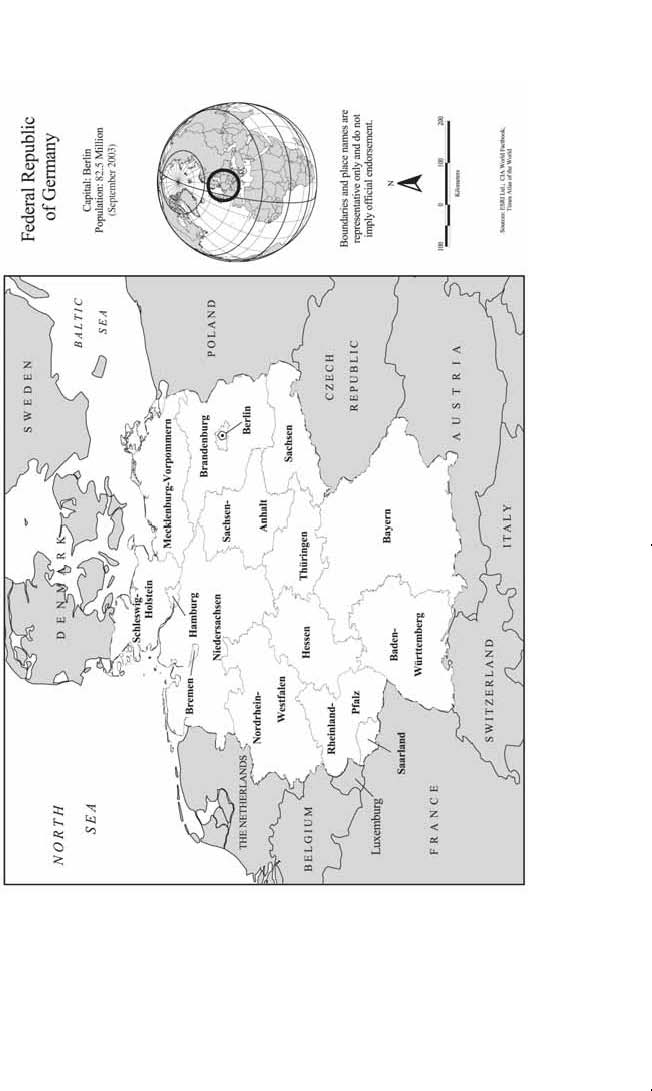
Following the collapse of the Communist regime in the gdr, and in the context of the reunification process in 1990, the five original Länder were re-established and the reunified Germany now consists of 16 Länder. An attempt to bring about a merger of Berlin and Brandenburg failed in a referendum held in these two Länder in May 1996, much to the disappointment of those who had hoped that a positive decision would increase the possibility of territorial reform throughout Germany. A second attempt, now under preparation, may be successful.
Since 1949 the federal system in the frg has developed towards a pattern of interlocking relationships between the federal and Länder governments due to the following factors:
There have been a number of attempts to reform German federalism.
From 1973–76 a special commission (Enquete-Kommission Verfassungsreform) discussed a comprehensive reform of the constitution and half of
the proposals made referred to federalism. None of these, however, was taken up and introduced in the Basic Law. In the 1980s there were attempts to strengthen the Länder by reducing the fields for Joint Tasks, by self-restraint on the part of the federation in its legislative activity, and by improving the financial basis of the Länder. These attempts did not succeed, however. Both the overall economic situation and, since 1990, the challenge of reunification, have negatively affected the financial freedom of manoeuvre of all the entities in the federal system. From 1992–94 a joint commission of the Bundestag and Bundesrat discussed reforms of the constitution which might be necessary as a consequence of reunification. With the exception of a few minor modifications, however, the federal system remained unchanged. Decisions on constitutional provisions are difficult as they require a two-thirds-majority in the Bundestag and the Bundesrat, which means an agreement of the two major parties.
2 constitutional provisions relating to federalism
The Länder as constituent units of the frg have the quality of states, with their own institutions. The constitutional order of the Länder has to conform to basic principles, such as basic human rights, democracy, rule of law, and it has to provide for directly elected political representation of the citizens (Article 28). Each of the Länder has a parliamentary system of government, with a directly elected Parliament (with a four or five year legislative term) and a government accountable to it. The Länder constitutions differ, however, in terms of provisions on special aspects of the governmental system, such as referendums, government formation procedures, provisions on motions of non-confidence or votes of confidence, individual accountability of ministers, etc. There are also differences concerning rights; in the constitutions of the five new Länder we find, for example, provisions on both basic human rights and social rights (including employment, environment, housing, education, etc.).
According to the “eternity clause” in Article 79.3 the federal system as such must not be abolished. Territorial reform is, however, possible which means that there is no guarantee of the existence or territorial integrity of individual Länder. The Basic Law envisages two procedural routes for territorial reform: a very complicated procedure (Article 29) which is seen as a barrier to reform; and a clause (following the model of Article 118 for reform in the German southwest, as mentioned earlier) relating to the special case of Berlin and Brandenburg (Article 118(a)), allowing territorial reform via bilateral agreement, including a referendum in both Länder.
The constitution sets out the division of legislative powers between the federation and the Länder. Matters falling into the exclusive jurisdiction of the federation are listed in Article 73. Matters falling into concurrent jurisdiction are listed in Article 74, and matters for which the federation has the right for framework legislation are in Article 75 (a framework law gives only a general outline and requires subsequent Länder legislation, thus allowing the Länder to decide on details). Article 72 sets out conditions under which the federation may legislate in matters falling into concurrent jurisdiction, namely “if and to the extent that the creation of equal living conditions throughout the country or the maintenance of legal and economic unity makes federal legislation necessary in the national interest.” Article 70 stipulates that “the Länder have the right to legislate insofar as this Basic Law does not confer legislative powers on the Federation.” Their exclusive competencies are, however, restricted to issues in connection with their own constitutions and related to the local level, to the organization of the administration, and to matters relating to police and public order, culture, the media and education.
It is a feature of German federalism that the Länder are responsible for implementing federal legislation in their own right (Article 83). There are very few examples of direct federal administration (matters such as foreign service, the army, border control, air traffic, waterways, inland navigation and federal finances including customs are under direct federal administration).
The Länder participate in federal legislation via the Bundesrat. It is composed of members of the Land governments, and the number of votes varies as follows: each Land has at least three votes; Länder with more than two million inhabitants have four; Länder with more than six million inhabitants five; and Länder with more than seven million inhabitants six votes (Article 51.2). The votes of each Land have to be cast uniformly (in practice as a block vote by one Land government member) and cannot be split. Participation in federal legislation applies, first, to the right of the Bundesrat to initiate federal legislation and submit a bill, as do the Bundestag and the federal government. Second, each bill, after having been adopted by the Bundestag, has then to be submitted to the Bundesrat. There are two categories of laws: those which require the explicit consent of the Bundesrat, with a majority of its votes; and those which do not. This second category gives the Bundesrat a suspensive veto which, after a limited period of time, can be overruled by the Bundestag with an absolute majority (or two-thirds majority if two-thirds of the Bundesrat votes have been cast against). The major criteria for laws requiring approval in the Bundesrat are that the law would affect administrative powers of the Länder (they have to implement federal legislation) or have financial implications for the Länder. More than half of all federal legislation at present falls into this category.
The constitution provides, in this context, for a special mediation procedure – the “Mediation Committee” (Vermittlungsausschuss) – which is composed of an equal number of members from the Bundesrat (16, one for each Land government) and the Bundestag (16, selected according to party strength). The function of the committee is to find a consensus which is submitted to both Houses for approval. This Mediation Committee can be called upon by the Bundesrat, the Bundestag and the federal government.
In terms of financial arrangements, the constitution provides that the most important tax revenues are shared between the federation and the Länder. Thus income and corporate taxes are shared half and half, and the Value-Added Tax (vat) is shared in a ratio which has to be adjusted every three years by federal legislation requiring Bundesrat approval. Other tax revenues are apportioned either to the federation (e.g., excise duties) or the Länder (e.g., property, inheritance, motor vehicle and beer taxes). Of particular importance are mechanisms and measures of financial equalization between the federation and Länder and, horizontally, amongst the Länder themselves.
Constitutional disputes, amongst them those related to the federal system, are resolved by the Federal Constitutional Court (Bundesverfassungsgericht), upon appeal by one of the disputing parties. The Court consists of 16 members elected (2/3 majority) by an electoral body composed jointly of members of the Bundestag and Bundesrat.
In its decisions, the Federal Constitutional Court has repeatedly formulated and confirmed the principle of federal comity (Bundestreue) which is seen as representing a basic feature of the German federal system, even if there is no explicit clause in the constitution. This principle obliges the federation and Länder to consider, when conducting their affairs, the concerns of the other side.
3 recent political dynamics
There are three issues which have substantial implications for German federalism: the consequences of reunification; the challenge of European integration; and initiatives towards a comprehensive reform of the federal system.
Reunification has increased the economic and financial disparities amongst the Länder. This has had the result that weaker Länder are more dependent on the federation and thus the federation could win additional weight, which could have consequences for the overall federal balance. Furthermore, the system of horizontal financial equalization (horizontaler Finanzausgleich) has been affected by the widening gap. All five new Länder – Brandenburg, Mecklenburg-Vorpommern, Sachsen, Sachsen-Anhalt and Thüringen – belong to the group of net-receivers, with consequences for previous net-receivers (they may become net-payers or, at least, suffer some losses) and the “traditional” net-payers (their burden, transfer payments, may grow). And, finally, the party system in the five new Länder differs from the pattern in the “old” Länder, with the Partei des Demokratischen Sozialismus (pds) – the successor of the Communist Party in the former gdr – becoming a third force beside the Christian Democratic Union (Christlich Demokratische Union (cdu)) and Social Democratic Party (Sozialdemokratische Partei Deutschlands (spd)), and the fact that the Liberals (Free Democratic Party/Freie Demokratische Partei (fdp)) and the Greens are not represented in the respective Land Parliaments. This has had consequences for coalition patterns (spd with pds, or grand coalitions, if one party cannot form a majority on its own) which may have an impact on political developments in German politics as a whole.
The deepening process of European integration has posed a persistent challenge to the legal status of the Länder and therefore to the federal structure of the frg. The first challenge arises from the fact that the European Union (eu) has extended its functional scope considerably which means that eu activities fall into areas which have been reserved to the Länder in the internal allocation of competencies. The second challenge has arisen from the modalities of eu decision making. In the eu, the Council of Ministers is the most important decision-making and legislative body, and Germany is represented in the Council by the federal government. This means participation of the federal government in decisions in fields belonging to the exclusive competence of the Länder. The third challenge lies in the field of implementation of European legislation in Germany; this is primarily the responsibility of the Länder which until recently had no opportunity to influence the legislation and thus saw themselves under a strong degree of control by the federal government.
The Länder have reacted to this challenge successfully. First, they established in 1992–93 (in the new Article 23, supplemented by the “Law on the Cooperation of Federation and Länder in Affairs of the eu”) rights of participation in dealing with eu matters at the domestic level. The federal government now has to consider Länder concerns, formulated by the Bundesrat, and in matters which fall under the exclusive competence of the Länder, is even obliged to hold to the Bundesrat view. A further transfer of sovereign powers when this would alter the content of the Basic Law requires a two-thirds majority in support of the measure in the Bundesrat. Second, the Länder have established and developed autonomous eu activities (e.g., setting up representatives in Brussels and lobbying directly). Finally, they have acquired the right to participate formally and directly in the decision-making process at the eu level. They are represented in the Committee of the Regions established in 1993 (in an advisory capacity only), and they can represent Germany in the Council when matters falling under their jurisdiction are on the agenda. In addition, the new Article 24.1(a) allows the Länder to transfer (subject to federal government consent) sovereign powers to cross-border institutions insofar as the Länder have the competence in the policy fields concerned. On the whole, the position of the Länder has been strengthened. This is illustrated by the fact that two Länder representatives have participated in governmental conferences (Amsterdam 1996 and Nice 2000) on reforms of the eu-treaties; and that the Bundesrat and Bundestag were represented by one member each in the convention on the eu constitution in 2002/2003.
The thorough and substantial reform of federalism has been on the political agenda since the 1980s with the Länder – amongst them primarily the stronger ones – pushing towards “competitive federalism” (Wettbewerbsföderalismus) instead of “participatory federalism” (Beteiligungsföderalismus). They demand an increase in their autonomous competencies, combined with the reduction of federal level activities (e.g., in the areas of concurrent and framework legislative powers). Second, they are interested in further extending their freedom of manoeuvre in cross-border activities and “external” relations. Here they refer to functional needs in connection with the eu “Internal Market” policy (i.e., abolish internal economic borders and create a unified market for all eu member countries) and the new geographical centrality of Germany with a larger number of neighbouring countries in an enlarging eu.
The third topic, which is very controversial amongst the Länder themselves but vis-à-vis the federation as well, has to do with the financial system. The stronger Länder (as net-payers) are trying hard (by appealing to the Federal Constitutional Court and through political negotiations aiming towards a consensual new equalization system) to reduce their burden. The weaker Länder (as net-receivers) insist on solidarity both from the federation (which they expect to allocate additional resources to them in connection with extending their legislative autonomy) and from the stronger Länder, and believe that financial equalization, even if reduced, should continue. Since all changes would affect vested interests, one can only expect modest reform.
In spring 2003 the federal government and the Prime Ministers of the Länder submitted their reform proposals as the basis for political negotiations. They agree on demanding an end to the interlocking relationship, but they differ on what measures should be taken and which deserve priority. In summer 2003 both sides agreed to set up a bicameral committee to consider the modernization of German federalism and elaborate proposals for constitutional reform. The committee is expected to report at the end of 2004.
The following issues are at the centre of the reform agenda which has been discussed widely since 2000/01:
In November 2003 a bicameral committee (Kommission Bundesstaatsreform) was established formally and started its work. More radical reform proposals have been submitted from outside the committee (e.g., to replace the Bundesrat by a US-type Senate; to abolish the block-vote of each Land in the Bundesrat; to give the Länder the right to impose their own taxes or to differ from the average rates for particular categories of taxes). With the establishment of this committee both sides have generated great expectations in the public that substantial reform of German federalism will be achieved. However, as any changes will affect established interests, it is likely that only a balanced package deal will enable success.
4 sources for further information
Gunlicks, Arthur, The Länder and German Federalism, Manchester,
Manchester University Press, 2003. Hrbek, Rudolf and Annegret Eppler (eds), Deutschland vor der Foederal
ismus-Reform. Eine Dokumentation, Europäisches Zentrum für Föderal
ismus-Forschung Tübingen, Occasional Papers No. 28, 2003. Jeffery, Charlie (ed.), Recasting German Federalism. The Legacies of Unifi
cation, London/New York: Cassell, 1999.
Laufer, Heinz and Ursula Münch, Das foederative System der Bundesrepublik Deutschland, Opladen: 1998.
Leonardy, Uwe, The Institutional Structures of German Federalism, London, 1999 (electronic edition, Bonn: Friedrich Ebert Stiftung, Digitale Bibliothek, 1999).
Sturm, Roland, Foederalismus in Deutschland, München: 2003. Wehling, Hans-Georg (ed.), Die deutschen Länder. Geschichte, Politik,
Wirtschaft, Opladen: 2000. http://www.gksoft.com/govt/en/de.html http://www.bundesrat.de
Table I Political and Geographic Indicators
| Capital city | Berlin |
| Number and type of constitu | 16 States (Länder): Baden-Württemberg, Bavaria, Berlin, |
| ent units | Brandenburg, Bremen, Hamburg, Hessen, Mecklenburg- |
| Vorpommern, Niedersachsen, North Rhine- | |
| Westfalen, Rheinland-Pfalz, Saarland, Sachsen, Sachsen- | |
| Anhalt, Schleswig-Holstein, Thueringen | |
| Official language(s) | German |
| Area | 356 970 km² |
Area – Largest constituent unit Bavaria – 70 548 km²
| Area – Smallest constituent unit Total population Population by constituent unit (% of total population) | Bremen – 404 km² 82 542 000 (September 2003) North Rhine-Westfalen 21.9%, Bavaria 15.0%, Baden-Württemberg 12.9%, Niedersachsen 9.7%, Hessen 7.4%, Sachsen 5.3%, Rheinland-Pfalz 4.9%, Berlin 4.1%, Schleswig-Holstein 3.4%, Sachsen-Anhalt 3.1%, Brandenburg 3.1%, Thueringen 2.9%, Mecklenburg-Vorpommern 2.1%, Hamburg 2.1%, Saarland 1.3%, Bremen 0.8% |
| Political system – federal | Federal Republic |
| Head of state – federal | President Johannes Rau (1999) ((spd) Social Democratic Party). Elected for a 5-year term by members of the federal Parliament and an equal number of delegates elected by the Länder legislatures. At the Chancellor’s suggestion, the President appoints the federal ministers, federal judges and federal officials – and nominates the Federal Chancellor for election by the Bundestag. |
| Head of government – federal Government structure – federal | Chancellor Gerhard Schröder (1998, re-elected 2002) ((spd) Social Democratic Party), elected by the Bundestag for a 4-year term. Election last held 22 September 2002. Bicameral: Parliament Upper House: Bundesrat. Representation of the Länder. There are 69 members, indirectly elected by the Länder legislatures from 16 multi-seat states (with a range of 3-6 per state, depending upon the population of each Land). Members are elected for the term of the respective Land government. Lower House: Bundestag, usually consists of 598 members. The 15th Bundestag, elected on 22 September 2002, has 603 members due to the so-called surplus mandates or Ueberhangmandate. Members |
Table I (continued)
are elected by direct popular vote through a “mixedmember proportional system,” which combines 299 single-member constituencies with 299 seats allotted through proportional representation. Members are elected for a 4-year term.
| Number of representatives in lower house of federal government for most populated constituent unit | North Rhine-Westfalen – 134 |
| Number of representatives in lower house of federal government for least populated constituent unit | Bremen – 4 |
| Distribution of representation in upper house of federal government | 69 seats: Each Land has at least three seats in the Bundesrat; Länder with more than 2 million inhabitants have 4 seats, Länder with more than six million |
| inhabitants have 5 seats, Länder with more than 7 mil | |
| lion inhabitants have 6 seats. The presidency of the Bundesrat rotates annually among the Länder. By law, each Land delegation is required to vote as a bloc in accordance with the instructions of the Land govern | |
| ment. |
Distribution of powers The federal government legislates while the Länder execute federal laws. The federal government has exclusive powers over foreign affairs, defence, citizenship, immigration, international commerce, customs, currency, coinage, copyrights and nationwide public services. Concurrent powers include matters such as criminal, civil, economic, labour, agricultural codes of law, public welfare, real estate transactions, road traffic and non-federal railroads.
The Länder have the right to legislate on matters as long as legislative powers has not been given to the Federation. Their exclusive competencies are related to the local level, including the organization of the administration, police and public order, culture, the media and education. In the event of conflict between federal law and states law, the federal law prevails.
Residual powers Residual powers belong to the Länder.
Constitutional court (highest court dealing with constitutional matters)
Political system of constituent units
Federal Constitutional Court. 16 members. Half of the judges are elected by the Bundestag, and the other half by the Bundesrat, for 1 term of 12 years with no reelection.
Unicameral – Legislatures (Landtag). Composition varies from Land to Land.
Head of government – constit-Prime Minister or Mayor uent units
Table II Economic and Social Indicators
gdp us$2.2 trillion at ppp (2002)
gdp per capita us$26 600 at ppp (2002)
Mechanisms for taxation us$3 062 billion (June 2003)
National debt (external) us$446.6 billion (2002)
National unemployment rate 10.4% (December 2003)
| Constituent unit with highest unemployment rate | Sachsen-Anhalt – 19.6% |
| Constituent unit with lowest | Baden-Württemberg – 5.4% |
| unemployment rate | |
| Adult literacy rate | 99%1 |
| National expenditures on | 4.6% |
| education as a % of gdp | |
| Life expectancy in years | 78.0 |
| Federal government revenues – from taxes and related sources | us$78.6 billion (2002) |
| Cosntituent unit revenues – from taxes and related | us$31.5 billion (2002) |
| sources) | |
| Federal transfers to constituent units | us$14.8 billion (preliminary 2002) |
| Equalization mechanisms | Formula-based equalization through inter-state transfers plus federal transfers. |
Sources
Bundesbank, “Gross External Debt Position.” June 2003, web site: http:// www.bundesbank.de/stat/download/stat_auslandsverschuldung/ stat_sdds_auslandsverschuldung.en_0603.pdf
Germany, Government of, “Elections 2002,” web site: http://www.germany-info.org/ relaunch/info/publications/infocus/Elections/Election_process.html
Germany, Government of, Federal Statistical Office, “Finance and taxes: Cash tax revenue,” “Finance and taxes: Debt,” “Finance and taxes: Länder government revenue shareing scheme,” web site: http://www.destatis.de/basis/e/fist/ fisttab01.htm
Organisation for Economic Co-operation and Development, “Managing Across Levels of Government: Germany,” web site: http://www.oecd.org/dataoecd/10/0/ 1902398.pdf
Organisation for Economic Co-operation and Development, “oecd in Figures: Statistics on the Member Countries.” September 2003, web site: http://www1.oecd.org/ publications/e-book/0103061E.PDF
United Nations Development Programme, Human Development Report 2003: Human Development Index, web site: http://www.undp.org/hdr2003/pdf/hdr03_HDI.pdf
Universität Bern – Institut fur offentliches Recht, “International Constitutional Law: Germany,” web site: http://www.oefre.unibe.ch/law/the_basic_law.pdf
Watts, Ronald L. 1999. Comparing Federal Systems. Second Edition. Kingston: Institute of Intergovernmental Relations, Queen’s University.
World Directory of Parliamentary Libraries: Germany. Available from German Bundestag web site: http://www.bundestag.de/bic/bibliothek/library/germa.html
Note
1 Age 15 and above.