YEMILE MIZRAHI*
1 history and development of federalism
Ever since 1810, when Mexico became an independent country, tensions between the states and the centre have dominated the political landscape. Indeed, the war of independence started in the states as a reaction to the excesses of a powerful central government. The precarious equilibrium between the centre and the periphery in Mexico has been crystallized in the different constitutions that have been drafted since independence.
The first constitution, the Constitución de Cádiz of 1812, was modelled after the Spanish system and defined two institutions at the regional level: municipal and state governments. Municipal governments were elected, but the state governments were appointed by the central government. This constitutional arrangement allowed the first independent government of Mexico, the short-lived monarchy of Agustín de Iturbide, to centralize power in the capital.
In 1824 an insurrection led by General Santa Anna forced Iturbide to resign, and he was later assassinated. With the downfall of the monarchy, the states reacted by establishing their own governments. In the new Constituent Assembly (1823–24), representatives of the
* The author would like to thank Juan Espindola for his valuable assistance in the preparation of this article.
state governments were able to exert a considerable influence in the drafting of the new constitution. It was in the 1824 constitution that federalism was first introduced. It was conceived by the Constituent Assembly as an institutional mechanism to preserve the union and prevent the secession of several states and, thus, what it reveals most is a fear of national disintegration. This is why its drafters sought to create a strong executive while at the same time recognizing some form of state autonomy and the separation of powers among the executive, legislative and judicial branches of government.
The tensions between the states and the centre made the 1824 constitution inoperable. The desire for independence on the part of some states could not be contained, and thus, in 1836 Texas declared its independence from Mexico. More importantly, the tensions between the Liberals (federalists) and the Conservatives (centralists) seriously divided the country. Political instability was so high that no government was able to rule effectively. By 1835, a new Constituent Assembly had amended the constitution and eliminated federalism as a form of government. The centralization of power became more explicit during the dictatorships that followed.
In 1857 a new constitution was drafted after dictator Antonio López Santa Anna was removed during an armed insurrection. In reaction to the strong powers granted to the executive in the 1824 constitution, the 1857 constitution sought to limit the power of the executive by strengthening Congress. As a mechanism to do this, the constitution eliminated the Senate. It was thought that a single legislative chamber would be more powerful and more effective in checking the power of the executive. Although this constitution recognized federalism as a system of government, it granted the central government great economic and political powers vis-à-vis the states. Moreover, by eliminating the Senate, the states lost their representation in the federal government.
In practice, this constitution also proved unmanageable, particularly given the political instability that was still prevalent in the country, and given that it did not create the institutional mechanisms to allow the executive to govern effectively. As Marván argues, this constitutional design granted Congress enormous power without accountability or appropriate checks and balances, and at the same time, granted the executive enormous responsibilities without sufficient autonomy.1
1 Ignacio Marván, ¿ Y después del presidencialismo qué? Reflexiones para un nuevo régimen constitucional? México: Océano, 1998, p.54.
The 1857 constitution was drafted by the Liberals, and the Conservatives’ opposition to it culminated in a civil war. The war between Conservatives and Liberals ended with the victory of the Liberals in 1867. In order to strengthen the executive, President Benito Juárez sought to reform the constitution and, although he died in 1872, a constitutional amendment was passed which re-installed the Senate in 1875. Juárez promoted the Senate as a means of strengthening the central government which he thought was necessary in order to reconstruct the country. The fact that the Senate was re-established did not mean that it was empowered, however, as many prerogatives remained with Congress – for example, the ratification of all Cabinet members and Supreme Court justices, the suppression of the presidential veto, and the right to subject the President to a political trial with a simple majority. Also, the Senate was excluded from participating in the discussion and approval of the budget. With this limitation, federalism was impaired, for the states were excluded from taking part in the budgetary decision-making process. This limitation continues to the present.
Porfiro Díaz took power in 1876. This began a period of prolonged and repressive dictatorship. Although during his time in power Juárez used extraordinary provisions to govern and suspended individual rights, the regime of Porfiro Diaz took this to greater extremes. Díaz gained control over the press, the Church, Congress, Governors and local elites. He also managed to amend the constitution to allow for his indefinite re-election.
A severe economic crisis, combined with popular disenchantment with a repressive regime that rested on a highly unequal distribution of wealth, and the emergence of a new generation of leaders who reacted against the entrenchment of a political elite who obstructed their political ambitions, made the conditions ripe for revolution and indeed that is what happened. In 1910, the start of the Mexican Revolution forced Porfirio Díaz to leave the country. As in the past, the revolution originated in the periphery, but was won in the centre. It ended when two moderate northern generals (Venustiano Carranza and Alvaro Obregón) defeated the more radical faction. Carranza and Obregón consolidated their victory when they took control of the centre and were able to dominate the periphery.
After the civil war, a Constitutional Assembly was convened to draft a new constitution. The constitution of 1917 was modelled after the 1857 constitution and the 1875 amendments, but it granted the executive greater discretionary powers and it included a series of “social rights” (education, labour, health) that institutionalized the ideals of the Revolution. This constitution, which is still valid today, became one of the most important institutional pillars of Mexico’s political regime.
The other major pillar of the regime was the official party, the Partido Revolucionario Institucional (pri), which maintained virtually hegemonic control of power from its creation in 1929 to 2000. With the victory of an opposition candidate in the 2000 presidential elections, a significant number of politicians, academics and journalists have started to talk about the need to draft a new constitution.
2 constitutional provisions relating to federalism
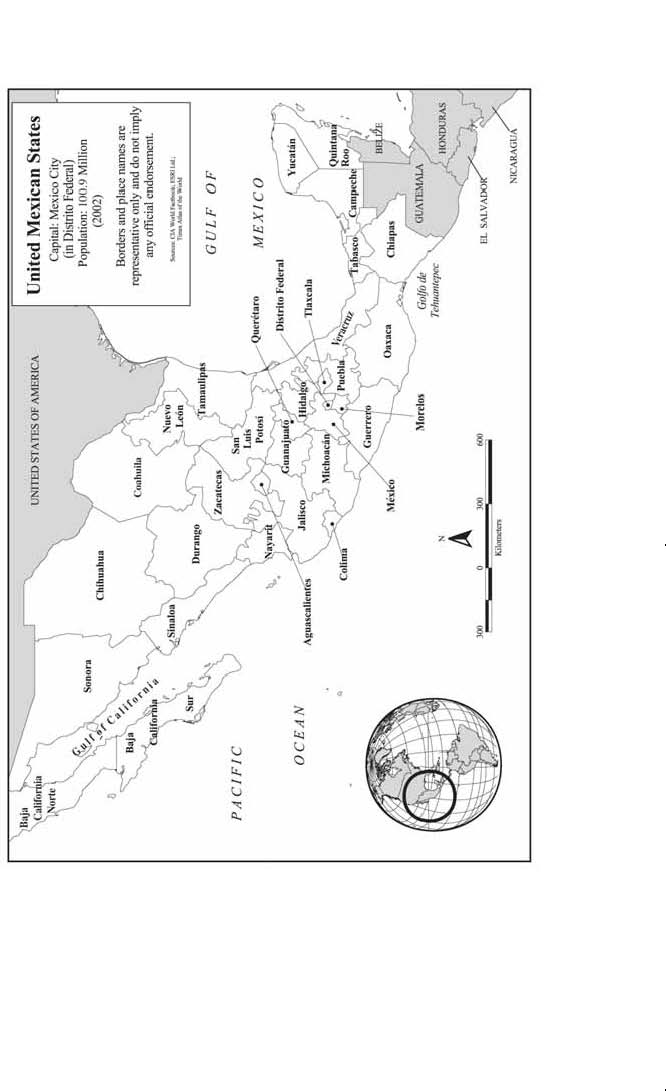
According to the 1917 constitution, Mexico is a “federal, democratic, and representative republic, composed of free and sovereign states in regard to their internal regime” (Article 40). It is divided into 31 states and one Federal District (Mexico City). Although the constitution declares that Mexico is federal, in practice however, the country has been extremely centralized, both politically and economically, and until recently, it was neither democratic nor representative. Centralization of power became part and parcel of the construction of the national state after the Revolution. The constitution grants the federal government, and particularly the President, vast discretionary powers. An authentic federal system, as was formally stipulated in the constitution, would have undermined the pacification of the country in 1917, for there were regional chiefs hoping to impose their rule in their territories.
The President has substantial powers. According to the constitution, the President can appoint all members of his Cabinet without the ratification of Congress, with the exception of the Attorney-General, the head of the armed forces, and ambassadors (Article 89(II)). The President can introduce legislation to Congress (Article 71(I)), and also names the Justices of the Supreme Court (Articles 94–107) with Senate approval (Article 89(III)). From 1928 (when a constitutional amendment eliminated local government in the Federal District) to 1997, the President also appointed local officials in the Federal District. This provision was changed in 1997 when people in the Federal District were able to choose their mayor for the first time.
The division of power is heavily weighted in favour of the central government. Until the introduction of reforms to decentralize health and education in the 1990s, the federal government had exclusive responsibility in a host of policy areas like commerce, education, health, labour, agriculture, energy, natural resources and food policy. The federal government also possesses enormous financial and economic power. According to the constitution, the powers not explicitly defined for the federal government are reserved for the states. However, virtually all articles in the constitution contain restrictions that limit the power of the states.
In terms of fiscal power, the federal government collects all income tax and, since 1980, it also collects all consumption taxes. While states and municipalities receive a share of tax collection, the criteria for distributing financial resources to sub-national governments have been a matter of controversy, particularly after opposition parties started to win elections at the local and state level. The federal government can also invest in the states with a high degree of discretion. There are no formulae or rules to determine how much the federal government invests in each state.
The Senate provides for the representation of states in the central government. It is made up of 128 members. Each of the 31 states, and the Federal District, elects two members through a majority principle. As well, one seat per state and the Federal District is assigned to the person who came second in the Senate election in that state. (This was a concession granted by the government – at a time when the pri was still in power everywhere – to allow the opposition to obtain seats in the Senate without much of a sacrifice to the power of the pri.) The remaining 32 Senators are elected through proportional representation, not on a state basis but using the country as a whole as a constituency (Article 56). This means that these 32 Senators are not elected to represent a constituent unit.
A term in the Senate is six years. In addition to ratifying the selection of Supreme Court Justices, ambassadors, the Attorney-General and the head of the Mexican National Bank, the Senate approves all international treaties, and participates in the legislative process. As mentioned earlier, however, the Senate cannot participate in the approval of the budget, so Senators are excluded from taking part in deciding how much is spent in their states, and how it is spent.
Despite the centralizing tendencies of the constitution, Article 135 provides a role for Congress and the states to play in the amendment process. Thus, amendments to the constitution must be approved by two-thirds of the members of Congress and by a majority of state legislatures.
One of the most interesting and influential elements in the constitution is its prohibition on re-election. To prevent the perpetuation of the executive in power, the constitution forbids re-election of all elected officials. Originally, Municipal Presidents and Deputies could be re-elected, but in 1933, the pri introduced a constitutional amendment banning re-election of all officials. This was in large part designed by the pri to permit the circulation of elites – for, lacking effective competition for office, the pri became the central mechanism to gain access to power. Thus, a great number of elected positions regularly became available for the pri to distribute to its supporters and followers.
In 1983 the government introduced a constitutional reform proposal that sought to strengthen the authority and institutional capacity of lo-cal/municipal governments in Mexico. The proposal explicitly defined the powers and responsibilities of municipal governments. Among other things, municipal governments were granted authority over the collection of property taxes and were given responsibility for investing and administering a host of public services. However, these changes benefited mainly urban municipalities – those that could collect property tax and could provide urban services. For the majority of the country, which is rural and poor, these reforms were much less relevant. More importantly, without the possibility of re-election, institution-building is impaired because successful innovations in government do not have sufficient time to be institutionalized. Every three years new municipal authorities have to start from scratch.
Although the constitution certainly centralizes power in the hands of the executive, the centralization of power in Mexico would not have been possible without the long hegemony exerted by the ruling pri. From its creation in 1929 to the elections in 2000, the “official party” controlled the presidency without interruption. Until the mid-1980s, the pri also controlled all the states and the majority of the municipalities in the country. And until 1997, the pri had a majority in Congress. Without a functioning political opposition, federalism could not exist in Mexico.
Through the hegemony of the pri, which was maintained through a combination of legitimate popular support, skewed electoral rules and fraud, the President was able to subordinate state and local governments, both in political and economic matters. The President became the virtual leader of the party during his term in office (usurping the authority of the President of the party and the National Executive Committee), and not only decided who could run for all governorships, he also had enormous discretionary power to spend resources in the states and municipalities. Even though some resources were transferred to states and municipalities according to a well-established formula, the federal government still had ample room of manoeuvre to transfer resources to the states following political criteria.
The lack of political alternatives outside the pri fostered strong discipline inside the party. Lapses in discipline were severely punished by means that ranged from fiscal strangulation to political demotion. Governors became, in effect, representatives of the executive in the states. This state of affairs started to change during the 1980s when opposition parties gained strength and managed to win elections first at the local level and, after 1989, at the state level.
One other element of the Mexican system deserves mention here – the Supreme Court. Although a Supreme Court has existed in Mexico for many years, it has not played a major role in Mexican federalism. During the rule of Porfirio Diaz (which ended in 1910), the court was discouraged from intervening in political and electoral conflicts. This pattern remained until 1997 when the Court ruled that it had the authority to resolve these matters.
3 recent political dynamics
For many years, the centralization of Mexico’s political and economic life was not a matter of concern to the government. Until the late 1960s the economy was growing at a steady rate of six per cent per year with low levels of inflation. But once the economy started to decelerate during the 1970s, centralization began to be perceived as a problem and a major obstacle to equitable and sustainable economic development.
The legacies of centralization in Mexico have been extremely negative. These legacies include: a severe regional disequilibrium, with relatively rich and industrialized states in the north and extremely poor and undeveloped states in the south; a highly uneven distribution of income (among the most uneven in Latin America); and decreasing quality and efficiency in the services provided by the government, particularly education and health. With a slowing economy, the federal government became overloaded with many responsibilities and functions it could not meet.
During the 1970s the federal government recognized that decentralization was a tool that could be used to promote more equitable regional development and to divest itself of excessive responsibilities. At first, decentralization was more a rhetorical than a concrete policy project, but during the 1980s, and particularly during the 1990s, the government introduced serious decentralization efforts. Thus, health and education were transferred to the state governments, sub-national governments received greater resources, and the allocations of funds to states and municipal governments became less discretionary. However, in many respects, decentralization has been haphazard, for the federal government has retained the control over critical areas of decision making. For example, in education the federal government still fixes teacher wages and has control over educational materials. As well, state and municipal governments continue to be financially dependent on the federal government. Although the federal government has transferred more resources to sub-national governments, most of these resources are earmarked for specific projects. Both the state and local governments complain that these conditions severely limit their capacity to plan their own development strategies.
After the election of President Zedillo (1994–2000), federalism became a central issue in public debate. The eruption of the guerrilla insurgency in the southern state of Chiapas, the strengthening of the opposition in several states, and the severe economic crisis the country experienced in 1995, significantly reduced the federal government’s room for manoeuvre. Although the federal government still holds vast discretionary powers, President Zedillo believed that the excessive centralization of Mexico’s political and economic life was becoming a serious obstacle to addressing the extreme regional inequalities and the impoverishment of thousands of Mexicans. To strengthen state and local governments, and to reform financial inter-governmental relations, the government launched a new program, entitled “New Federalism.” This program sought to transfer more resources to states and municipalities, to reduce the discretionary power of the federal government in the allocation of funds, and to simplify and clarify the process of resource distribution to states and municipalities.
Although during the Zedillo administration states and municipalities received greater resources and were granted more responsibilities, many of the patterns of the past persisted. Mexico continued to be a highly centralized country, particularly compared to other Latin American countries. The federal government still continued to control most public spending – by 1996, the federal government was responsible for 75% of total expenditures, and in 1998, the federal government controlled 70.9% of total income, distributing 24.4% of total income to the states, and 4.7% to municipal governments.
In the past few years the federal government has reduced its share of expenditures at the sub-national level. More than 60% of total expenditures is now spent by state and local governments. However, states and municipalities still continue to be highly dependent on federal transfers. The increase of transfers has had the perverse effect of reducing the efforts made by these governments to raise their own income. And, most of the transfers are still earmarked for specific projects, which seriously restricts the capacity of states and local governments to plan their spending and decide on their priorities.
These are the dilemmas that confront the administration of President Vicente Fox. For him, federalism is not only a matter of transferring more resources to the states and municipalities. Having been Governor of the state of Guanajuato, President Fox believes that inter-governmental relations need to change and that states and municipalities need not only greater resources, but more decision-making power and greater financial responsibilities. This, however, has become quite problematic for his administration, since at the state and municipal level, some Governors and Mayors still rule in the traditional authoritarian fashion. Granting more decision-making authority and resources to these Governors would strengthen these authoritarian islands in the new democratic ocean. More importantly, as the failure of Fox’s government to pass new fiscal reform measures in 2002 revealed, many Governors and Mayors want more financial transfers from the federal government, but they do not want greater responsibility to increase their own sources of income.
The political conflict in 2000–01 between the federal government and the state of Yucatán clearly illustrated the new configuration of power and conflict between the federal and the state governments. In August 2000 the Governor of Yucatán, Víctor Cervera Pacheco, an old-time member of the pri and a typical cacique (authoritarian local chief) manipulated the process for selecting the new Electoral Council, a body in charge of organizing and supervising the gubernatorial elections in the state which were scheduled for May 2001. The opposition complained, claiming that the Electoral Council was not impartial and, therefore, could not guarantee a fair electoral process.
The case was taken to the Federal Electoral Tribunal, which ruled in favour of the opposition in October 2000. The Governor and the pri local deputies, however, defied this ruling, claiming that the Tribunal violated the autonomy of the state. The pri and the Governor defended their case using federalism as their banner. The federal government refused to use the police to force the Governor to comply with the Federal Electoral Tribunal’s decision. Instead, the opposition resorted to the Supreme Court. The conflict finally ended in April 2001 when the Supreme Court ruled against the Governor, and the Electoral Council was forced to dissolve. This is the first time in the history of contemporary Mexico that the Supreme Court has resolved a conflict between a state and the federal government.
As of the end of 2003, a new debate was emerging between the states and the federal government about the distribution of resources and power among the federal government, the states, and municipalities. In contrast to the past, however, this debate is taking place in the context of a much weaker presidency. The Partido Acción Nacional (pan) lost significant power in the mid-term Congressional elections of 2003 and President Fox has been widely criticized for not being able to pass any significant reforms during his first three years in office.
With unprecedented financial resources and with considerable influence over their legislators, Governors have been consistently gaining power vis-a-vis the federal government. The Conferencia Nacional de Gobernadores (conago), an organization first supported by Governors in the opposition (i.e., non-pan Governors) and today supported by all Governors, is leading an initiative to include a discussion on fiscal federalism on the political agenda. A national conference between representatives of the federal and sub-national governments will be held in February 2004 to discuss the distribution of decision-making power, financial responsibilities and financial transfers. The results of this conference could have a significant impact on the fiscal reforms which are expected to be introduced by the federal government again in 2004.
As in the past, one of the most difficult challenges is to overcome the legacy of mistrust that has existed between the federal and sub-national governments. The latter complain about an excessive earmarking of federal transfers – i.e., the tendency of the federal government to specify to what use funds can be put – and about the federal government’s lack of transparency in its handling of financial information. The former, however, fears that sub-national governments could become irresponsible if they were given more discretion in the use of federal transfers. Strengthening mechanisms to make governments more accountable for the way they spend public funds could contribute to overcoming this legacy of mistrust.
4 sources for further information
Camp, Roderic, Politics in Mexico: The Rise of Democracy, 4th ed.; Oxford:
Oxford University Press, 2001. Carmagnani, Marcelo (coord.), Federalismos latinoamericanos:México/
Brasil/Argentina, Mexico: El Colegio de México-fce, 1993. Chand, Vikram K., Mexico’s Political Awakening, Manchester, nh: Uni
versity of Notre Dame Press, 2001. Giugale, Marcelo and Steven Webb (eds), Achievements and Challenges of
Fiscal Decentralization. Lessons from Mexico, Washington, dc: The
World Bank, 2000. Martinez, Carlos and Alicia Ziccardi, “Límites y posibilidades para la
descentralización de las políticas sociales,” in Rolando Cordera y Ali
cia Ziccardi (eds), Las políticas sociales de México a fin del milenio. Descentralización, diseño y gestión, México: Miguel Angel Porrúa-unam, 2000.
Marván, Ignacio, ¿Y después del presidencialismo qué? Reflexiones para un nuevo régimen constitucional?, México: Océano, 1998.
Mazarr, Michael J., Mexico 2005: The Challenges of the New Millennium, Center for Stategic and International Studies, 1999.
Latin American Network Information Center, Institute of Latin American Studies, University of Texas, http://www.lanic.utexas.edu/la/ mexico/
Economic Commission for Latin America and the Caribbean (eclc), www.eclac.org/estadisticas
Ministry of Finance and Public Credit, Government of Mexico, www.shcp.gob.mx
Table I Political and Geographic Indicators
| Capital city | Mexico City |
| Number and type of constitu | 31 States: Aguascalientes, Baja California Norte, Baja |
| ent units | California Sur, Campeche, Chiapas, Chihuahua, |
| Coahuila de Zaragoza, Colima, Durango, Guanajuato, | |
| Guerrero, Hidalgo, Jalisco, México, Michoacán de | |
| Ocampo, Morelos, Nayarit, Nuevo León, Oaxaca, Pue | |
| bla, Querétaro de Arteaga, Quintana Roo, San Luis | |
| Potosí, Sinaloa, Sonora, Tabasco, Tamaulipas, Tlaxcala, | |
| Veracruz-Llave, Yucatán, Zacatecas | |
| 1 Federal District: Mexico City | |
| Official language(s) | Spanish |
| Area | 1 964 375 km² |
Area – largest constituent unit Chihuahua – 247 087 km²
| Area – smallest constituent unit Total population Population by constituent unit (% of total population) | Tlaxcala – 3 914 km² (Federal District – 1 479 km²) 100 921 000 (2002) México 13.4%, Federal District/Mexico City 8.8%, Veracruz-Llave 7.1%, Jalisco 6.5%, Puebla 5.2%, Guanajuato 4.8%, Michoacán de Ocampo 4.1%, Chiapas 4.0%, Nuevo León 3.9%, Oaxaca 3.5%, Guerrero 3.2%, Chihuahua 3.1%, Tamaulipas 2.8%, Sinaloa 2.6%, Baja California Norte 2.5%, San Luis Potosí 2.4%, Coahuila de Zaragoza 2.4%, Hidalgo 2.3%, Sonora 2.2%, Tabasco 2%, Yucatán 1.7%, Morelos 1.6%, Durango 1.5%, Querétaro de Arteaga 1.4%, Zacatecas 1.3%, Tlaxcala 1%, Aguascalientes 1%, Quintana Roo 0.9%, Nayarit 0.9%, Campeche 0.7%, Colima 0.6%, Baja California Sur 0.4% |
| Political system – federal | Federal Republic |
| Head of state – federal | President Vicente Fox Quesada (since 1 December 2000) (ac-pan). ac-pan includes the Alianza por cambio (Alliance for Change), which is comprised of the Partido Accion Nacional ((pan) National Action Party), and the Partido Verde Ecologista de Mexico ((pvem) Ecologist Green Party of Mexico). The President is elected by popular vote for a 6-year term, and cannot serve a second mandate; election last held 2 July 2000 (next to be held 2006). |
| Head of government – federal | President Vicente Fox Quesada (ac-pan) since 1 December 2000. President can appoint Cabinet members, except the Attorney-General, head of armed forces and ambassadors who must be ratified by the Senate. |
Table I (continued)
Government structure – federal
Bicameral: National Congress (Congreso de la Unión) Upper House – Senate (Cámara de Senadores), 128 seats. Members are elected for a 6-year term, and cannot seek re-election. Election last held 2 July 2000 for all of the seats (next to be held 2006).
Lower House – Federal Chamber of Deputies (Cámara Federal de Diputados), 500 seats. 300 members are directly elected by popular vote in single member districts. The remaining 200 are elected through proportional representation in five multi-member districts. Deputies cannot seek re-election. Election last held 6 July 2003 (next to be held 2006)
Number of representatives in México – 57 lower house of federal government of most populated constituent unit
Number of representatives in lower house of federal government for least populated constituent unit
Distribution of representation in upper house of federal government
Baja California Sur – 2
Each of the 31 states and the Federal District has 3 representatives in the Senate: 2 are elected by majority and 1 is assigned to the party with second highest number of votes. The remaining 32 senators are elected nationally through proportional representation.
| Distribution of powers | The federal powers are foreign affairs, defence, citizen |
| ship, immigration, international and interstate com | |
| merce, customs, currency, banking, industrial property | |
| rights, nationwide public services, economic planning | |
| and social development, health, and electric and | |
| nuclear energy. The federal government has the right | |
| of granting concessions for the exploitation of minerals | |
| and other products of the sub-soil (including oil and | |
| water). Education, cultural affairs and environment | |
| protection are a joint responsibility of the federal gov | |
| ernment, the states and the municipalities. States are | |
| responsible for overseeing local governments. | |
| Residual powers | Residual power belongs to the states. |
| Constitutional court (highest | Supreme Court of Justice of the Nation (Suprema |
| court dealing with constitu- | Corte de Justicia de la Nación). 11 Justices appointed by |
| tional matters) | the President and ratified by the Senate. |
Table I (continued)
| Political system of constituent units | Unicameral (referred to as Local Congress in the states; in the Federal District referred to as Legislative Assembly). Each state has its own constitution. Deputies are directly elected by popular vote through relative majority and proportional representation (according to the constitution of each state). Deputies serve for a period of 3 years and cannot seek re-election. |
| Head of state – constituent units | Governor (states) and Chief of Government/Mayor (Federal District). They are directly elected by popular vote for a 6-year term and cannot seek re-election. |
Table II Economic and Social Indicators
| gdp | us$878.7 billion at ppp (2002) |
| gdp per capita | us$8 707 at ppp (2002) |
| National debt (external) | us$140.1 billion (December 2002) |
| Sub-national debt | us$10 billion (September 2003) |
| National unemployment rate | 3.2 % (urban) Note: Mexico does not collect unemployment data on a state-wide basis. |
| Constituent unit with highest unemployment rate | Saltillo (urban area within Coahuila) – 7.7% (September 2003) |
| Constituent unit with lowest unemployment rate | Acapulco (urban area within Guerrero) – 0.8% (September 2003) |
| Life expectancy in years | 73.1 (2001) |
| Adult literacy rate | 91.4% (2001)1 |
| National expenditures on education as % of gdp | 4.4 % (1998–2000) |
| Federal government revenues – from taxes and related sources | us$57.3 billion (2003 prel.) |
| Constituent unit revenues collectively – from taxes and related sources | us$2.1 billion (2001) |
| Federal transfers to constituent units | us$16.1 billion (prel. 2003) |
| Equalization mechanisms | Formula-based transfers, mostly unconditional. |
Sources
Bank of Mexico, “Fideicomisos Instituidos en Relación Con La Agricultura.” 1997, web site: http://www.fira.gob.mx/oficinas/Oficinas.asp?Op=7&Of=9
Giugale, Marcelo M. and Steven B. Webb (eds). 2000. Achievements and Challenges of Fiscal Decentralization: Lessons from Mexico. World Bank: Washington, dc
Instituto Nacional de Estadística, Geografía e Informática (inegi), “Banco de Información Económica: Tasa de Desempleo Abierto (2002),” web site: http:// dgcnesyp.inegi.gob.mx/bdine/I10/I1000031.htm
Instituto Nacional de Estadística, Geografía e Informática (inegi), “XII Censo General De Población y Vivienda 2000: Entidades Federativas, Capitales y Población por Entidad,” web site: http://mapserver.inegi.gob.mx/geografia/espanol/datosgeogra/ basicos/estados/tabla-poblacion.cfm
Instituto Nacional de Estadística, Geografía e Informática (inegi), “Ingresos Públicos Estatales por Entidad Federativa.” 2001, web site: http://www.inegi.gob.mx/est/ contenidos/espanol/tematicos/mediano/med.asp?t=fipu10&c=5104
Instituto Nacional de Estadística, Geografía e Informática (inegi), “National Survey on Urban Employment: Press Release.” September 2003, web site: http:// www.inegi.gob.mx/inegi/contenidos/espanol/prensa/Boletines/Boletin/ Comunicados/Empleo%20y%20desempleo/2003/Octubre/comunica.pdf
Instituto Nacional de Estadística, Geografía e Informática (inegi), “Superficie Continental e Insular del Territorio Nacional,” web site: http:// mapserver.inegi.gob.mx/geografia/espanol/datosgeogra/extterri/ frontera.cfm?c=154
Mexico, Government of, Ministry of Finance, “Estadísticas Oportunas de Finanzas Públicas y Deuda Pública: Deuda pública de entidades federativas y municipios,” January-October 2003, “Mexico: Economic and Financial Statistics (Data Book).” September 2003, “Timely Public Finances and Public Debt Statistics: Financial Position of the Federal Government.” January-October 2003, web site: http:// www.shcp.gob.mx/index01.html
Mexico, Government of, Federal Electoral Institute, “Mexican Electoral System.” 2003, web site: http://www.ife.org.mx/
Mexico, Government of, “Senate: Structure and Organization,” web site: http:// www.senado.gob.mx/senado.php?ver=estructura&lng=en
Le Mexique aujourd’hui. August 2002. Bulletin d’information de l’ambassade du Mexique. Available from web site: http://www.sre.gob.mx/francia/mxau/mex26.pdf
Navarro, Carlos. 2000. Elections in North America in the year 2000. Available from The International Affairs Unit - Federal Electoral Institute web site: http:// www.ife.org.mx/wwwcai/B4-5ING.html
Senado de la República - LVIII Legislatura, Constitución Política de los Estados Unidos Mexicanos. 2002. First Edition. Mexico, pp. 74-77.
United Nations Development Programme, Human Development Report 2003: Human Development Index, web site: http://www.undp.org/hdr2003/pdf/hdr03_HDI.pdf
World Bank, “Quick Reference Tables: Data and Statistics,” web site: http:// www.worldbank.org/data/quickreference/quickref.html
World Directory of Parliamentary Libraries: Mexico. Available from German Bundestag web site: http://www.bundestag.de/bic/bibliothek/library/mexic.html
Note
1 Age 15 and above.