
Drafting Nepal’s language policy
Non-federal options might provide a better response to local needs
2009 26
Federations
BY SUJIT CHOUDHRY
 anguage will be one of the most important issues for the writers of
Nepal’s new constitution.
Linguistic nationalism has also been one of the principal forces shaping constitutional developments in Nepal’s neighbouring countries for more than 60 years. In pre-independence India, political mobilization led by Urdu-speaking elites ultimately led to partition. During the debates surrounding the adoption of India’s constitution, the move to make Hindi the sole official language produced the greatest conflict in the Constituent Assembly. Demands in the 1950s and 1960s by non-Hindi speakers led both to the development of India’s three-language policy and the creation of linguistic states.
India has been relatively successful in managing linguistic difference, compared to other countries in South Asia. In Sri Lanka, linguistic nationalism has been at the heart of ethnic conflict since the 1950s. The choice of Sinhala as the official language of government services and public-sector employment fuelled escalating demands by the Tamil-speaking community for language rights, federalism and, ultimately, secession. A final settlement of the conflict that does not directly address the claims of Tamil-speakers is doomed to failure. Pakistan is also a cautionary tale. Of the many areas of conflict between East and West Pakistan immediately after independence, an important one was language. Establishing Urdu as Pakistan’s official language, along with denigration of Bengali, helped lead to the secession of East Pakistan and the establishment of Bangladesh.
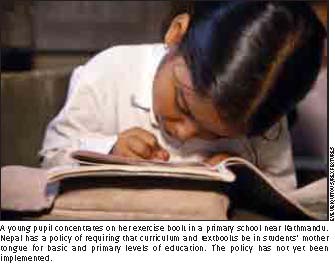
The cost of getting language policy wrong can be very high. To be sure, there are important historical differences between Nepal and other countries in South Asia. In India, Pakistan and Sri Lanka, linguistic nationalism has been inextricably tied to the history of colonialism and nation building. During the colonial era, English was one of the principal languages of public administration and was spoken by an elite few. After independence, as a colonial language, it could no longer play this role. An indigenous language, widely spoken or capable of being learned, had to serve as the heart of political and economic life, and indeed, was necessary for democratic consolidation. In contrast, Nepal was never colonized and has had relatively limited experience with democracy, so its linguistic politics have not been shaped by these forces.
Designating an official language
But, nonetheless, language has been a source of constitutional controversy in Nepal. Like its neighbours in South Asia, Nepal is linguistically extremely diverse. At least 90 languages are spoken in Nepal. Nepali is the mother tongue for approximately 48 per cent of the population. There are other widely spoken languages. In the Madhes, Maithili is spoken by 12.3 per cent of the people while Bhojpuri is spoken by 7.53 per cent of the population. In addition, among the languages of the Janajati, Tharu and Tamang have the most speakers. The 1990 constitution both recognized and drew a distinction
Sujit Choudhry is Scholl Chair and Associate Dean in the Faculty of Law, University of Toronto, Canada.
forumfed.org

among the different languages of Nepal. Article 4(1) declared “[a]ll the languages spoken in Nepal are the national languages of Nepal.” However, section 4(2) provided that only “Nepali in Devnagari script shall be the official language of Nepal.” Article 5 of the interim constitution repeats these provisions. The designation of Nepali as the sole official language by the 1990 constitution was interpreted by the Nepal Supreme Court as precluding municipalities from conferring official language status on other languages at the local level.
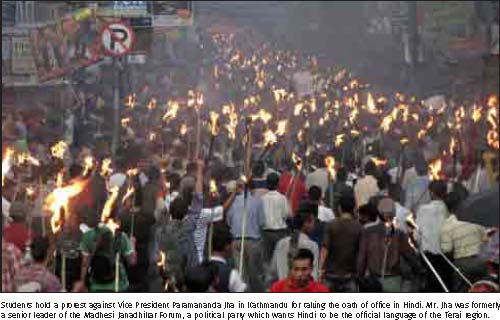
The designation of Nepali as the sole official language has generated enormous resentment, especially among Madhesi, who feel this has acted as a barrier to the civil service for them. Civil servants in the Terai are for the most part Nepali speaking Pahari who cannot or decline to communicate with the local population in their own language. Moreover, language has historically been caught up with controversies over citizenship. Finally, many Pahari consider Madhesi to be Indians, rather than Nepalis, and refuse to accept them as fellow citizens. This view was reflected in the rules governing Nepali citizenship set out in Article 9 of the 1990 constitution, which required spoken and written fluency in Nepali for naturalized citizens (including the spouses of women citizens of Nepal and their children). The net result is that many Madhesi who have been living in Nepal for generations lack citizenship.
Allowing linguistic diversity
The rise of political parties asserting the interests of the Madhes guarantees that language will remain a live constitutional issue. In grappling with it, there are in fact two sets of questions for Nepal to discuss. First, what does official language status actually mean? Second, how can constitutional design respond to linguistic diversity?
Why must states have an official language? States cannot be linguistically neutral, as they can on the basis of race, religion or ethnicity. States must choose one or a limited set of official languages in which to function, offer public services, legislate, run their schools, debate and enact laws. This choice, in turn, functions to distribute economic and political power. Economically, it provides privileged access to educational opportunities, economic well-being, and public-sector employment to speakers of the official language, and conversely, impedes such access to speakers of other languages. Politically, speakers of official languages enjoy privileged access to public offices and hence to public power, such as legislatures, courts and bureaucracies. So, not surprisingly, official language policies are the source of conflict in multilingual societies, as they have been in South Asia.
It is sometimes thought that once a language receives official language status, it can and should be treated equally across all areas of government activity. However, for the purposes of constitutional design, it is useful to disaggregate the choice of official language into a number of distinct institutional contexts. In each of those contexts, the scope for linguistic choice and the consequences of those choices are rather different.
Simplifying communication
For example, instead of referring to the official language of government it is more
2009 27
Federations
REUTERS/GOPAL CHITRAKAR
forumfed.org

useful to distinguish between the language of public service and the internal working language of government. The language of public services has understandably been a flashpoint of linguistic conflict in
multilingual societies. Moreover, the scope for linguistic choice is broad, because in theory, governments may communicate with their citizens in a broad range of languages, all of which carry official status for that purpose.
implementing a policy of multiple official languages. In its most extreme form, the centre and constituent units, sometimes called federal units, would have unfettered power to choose an official language, which could differ. A link
an issue, it is clear that federalism is not the only constitutional option. It is possible to have multiple official languages without a federal constitution. For instance, in the realm of public services, a national government could provide public services in different languages throughout
the country, tailored to
Equating language with federalism is widespread
the needs of local
throughout South Asia. The linguistic reorganization of
populations. A the Indian states, the secession of East Pakistan and national judicial
system could operate
the demand for a Tamil majority province or independent
in a similar manner; for
homeland in Sri Lanka are examples. Consequently, it is
example, with respectoften assumed in Nepal that adopting multiple official to languages in which
languages would necessarily go hand in hand with the
there is a sufficiently
2009 28
Federations
adoption of a federal structure.
By contrast, the scope for linguistic choice is much more limited with respect to the internal working language of government. From a practical standpoint, the state is limited in its ability to function internally in more than one language, in order to ensure that civil servants are able to communicate with each other. Translation for monolingual civil servants in a multilingual administration is both time-consuming and costly. In the context of a developing country such as Nepal, these challenges are even greater. This creates considerable pressure toward linguistic convergence within public administration, much more so than for the language of public services, where it is possible to use a broader array of languages. This has intensified linguistic politics in this arena, because the choice of internal working language has a dramatic effect on opportunities for public employment. Moreover, in economies where the public sector is large, the choice of internal working language has a standard-setting effect on the private sector because of the need for private entities to communicate with civil servants.
Implementing the language of federalism
The second set of issues concerns the relationship between official language policies and federalism. Some see federalism as the principal vehicle for language – the central official language or a third language (such as English), could be used between the centre and the constituent units. This is the Indian model. There are possible variations. For example, the constitution could offer choices for constituent units by providing a list of official languages from which to choose. Or it could set one official language for constituent units (perhaps the official language of the centre), but give them the power to adopt additional languages. The constitution could set the official language(s) of the constituent units. In all these variants, linguistic minorities within constituent units could be granted the right to minority-language education when they reach certain numbers.
Equating language with federalism is widespread throughout South Asia. The linguistic reorganization of the Indian states, the secession of East Pakistan and the demand for a Tamil majority province or independent homeland in Sri Lanka are examples. Consequently, it is often assumed in Nepal that adopting multiple official languages would necessarily go hand in hand with the adoption of a federal structure.
The link between federalism and multiple official languages is based, in part, on the assumption that official language status cannot be disaggregated. But once it is accepted that there are distinct spheres in which the choice of official language becomes developed legal
vocabulary. So too
with primary
education, which could entrench the right to mother-tongue education with or without federalism. Likewise, with the availability of simultaneous interpretation, the national legislature can operate in multiple official languages. These are separate from the internal working language of government, which would by necessity be limited to one or two languages. Under a non-federal model, municipal, regional or district governments could be bilingual, working in both the official language of the centre and a local language, as is the case in Kosovo, Macedonia and Finland.
There are hybrid options as well, which would combine multilingualism at the national level (for example, in the national legislature) with federalism where constituent units make choices regarding official language status that differ from those made at the centre. The overall point is that in addressing language policy through constitutional design, Nepal has a wide range of options to choose from. Moreover, in emphasizing self-rule mechanisms for dealing with linguistic diversity (that is, federalism), it should not overlook those that emphasize shared rule. If Nepal is to respond to the legitimate aspirations of its people for a share in the exercise of public power, federalism should be accompanied by the transformation of  the central government as well.
forumfed.org